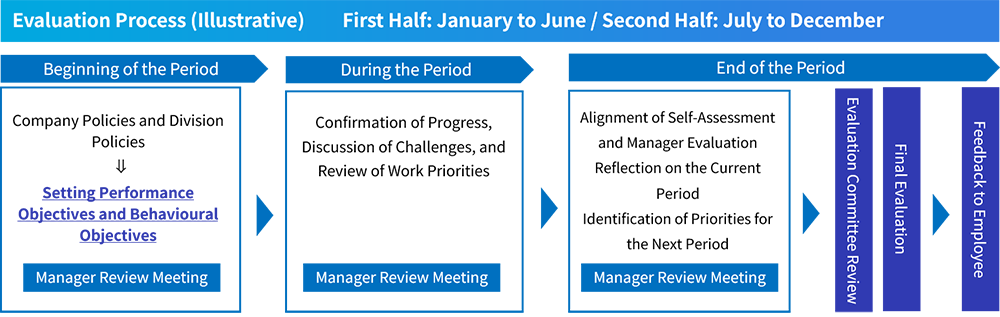
JAC Group operates an evaluation and remuneration system under which all employees are assessed fairly based on clear criteria and are rewarded in accordance with their achievements.
At JAC Group, employees are evaluated fairly according to clearly defined criteria based on both grade and job responsibilities. Evaluations are conducted twice a year under a management-by-objectives framework. At the beginning of each evaluation period, employees set their objectives, and performance is assessed from two perspectives: business results and the behaviours demonstrated in achieving those objectives. Employees meet with their managers three times during each evaluation period to review progress, discuss challenges, and reassess priorities where necessary. At the end of each evaluation period, employees and managers review self-assessments and manager evaluations together and hold an end-of-period review meeting to reflect on achievements and identify priorities for the next period. To ensure consistency and fairness, final evaluations are reviewed and confirmed through an evaluation committee before being communicated to employees. These regular discussions help employees gain a clear understanding of their achievements and development opportunities while enhancing transparency and fairness throughout the evaluation process.
JAC Group’s remuneration system is designed so that compensation is linked to an employee’s target performance and achievement rate. We believe that a fair and transparent remuneration system forms an important foundation for employees’ economic well-being. By ensuring appropriate rewards based on performance, the Group aims to enhance motivation, engagement, and job satisfaction. In FY2025, the Group introduced a number of revisions to further enhance employee motivation and strengthen overall organisational competitiveness.
1.Increase in Base Salary Ratios
To provide greater financial stability and create an environment in which employees can build long-term careers, the Group increased the proportion of fixed base salary.
◆Consultants: Base salary ratio increased by approximately 7.5%, with a corresponding adjustment to bonus ratios.
◆Middle and Back Office Employees: Base salary ratio increased by approximately 20%, with a corresponding adjustment to bonus ratios.
2.Increase in Base Salaries for New Graduates
Base salaries for newly hired graduates were increased to provide greater financial security and enable employees to concentrate on their work with confidence.
3.Revision of Remuneration for Management Positions in the Recruitment Business
A new management allowance was introduced, base salary ratios were increased by approximately 20%, and bonus ratios were adjusted accordingly.
4.Enhanced Rewards for Exceptional Performance
To maintain and further increase employee motivation, remuneration at higher levels of achievement was revised so that total annual compensation can exceed previous levels.
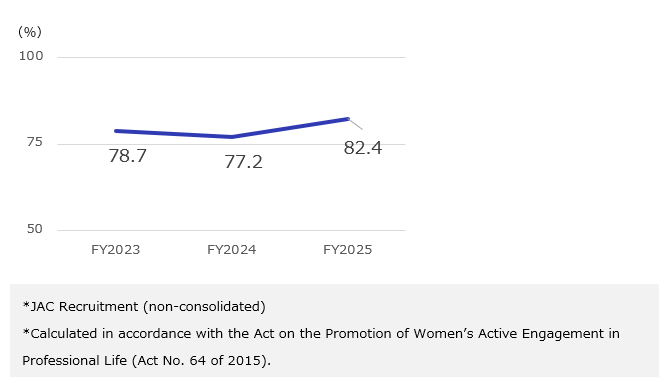
At JAC Recruitment, the gender pay ratio for FY2025 was 82.4%, representing an improvement of 5.2 percentage points year on year.The Group operates an evaluation and remuneration system based on job type and role, under which employees are assessed fairly according to their performance against assigned responsibilities and objectives, regardless of attributes such as gender or age.The Group is also actively promoting initiatives to support the advancement of women and create a workplace in which women can thrive. As a result, many female consultants continue to achieve outstanding performance. At the same time, we recognise that a gender pay gap remains and believe that the following factors contribute to this difference.
Factor 1: Difference in Management Representation
Women account for approximately 39% of employees, while the ratio of female managers is approximately 26%. One contributing factor is therefore the relatively lower representation of women in management positions, which are generally associated with higher levels of compensation.The Group is promoting a range of initiatives to support the advancement of women and aims to increase the ratio of female managers to 40% by 2030. We believe these efforts will also contribute to reducing the gender pay gap over time.
Factor 2: Differences in Consultant Grades
Within the consultant role, there are seven grades linked to performance, each with its own remuneration structure. Currently, the average grade of female consultants remains lower than that of male consultants.One reason for this is that the majority of employees join the Group through mid-career recruitment channels. In FY2025, approximately 72% of hires were mid-career recruits. While new graduates begin at the same grade, grades for mid-career hires are generally determined based on previous salary levels. Since female salary levels in the broader labour market have historically tended to be lower than those of men, differences may already exist when employees join the Group.To address this issue, the Group is strengthening the recruitment of highly experienced female consultants at higher grades. In addition, we operate a fast-track promotion system that allows consultants who achieve outstanding results to be promoted more quickly than under the standard framework. We believe this system will support the career development and advancement of female consultants and contribute to reducing the gender pay gap over the medium to long term.
Gender Pay Gap : All Employees