
Because revenue in the recruitment business are dependent on the number of consultants multiplied by productivity per consultant, enhancing both the “quantity” and “quality” of consultants is essential for sustainable growth. Our focus on strengthening recruitment and curbing turnover has enabled us to steadily increase the number of consultants, as well as strengthen our foundations for top-line growth through the promotion of robust training measures.
To achieve its goal of becoming the world’s No. 1 professional recruitment group in terms of quality and profitability, JAC Group has developed its own training programmes. The foundation of these programmes is the JAC Standard, which defines the service quality standards expected of consultants. To promote a thorough understanding of the JAC Standard throughout the Group, we have produced the JAC Standard Handbook, which outlines the fundamental knowledge, skills, and performance indicators expected of employees. The handbook is available in both Japanese and English, distributed to all Group employees, and used in a variety of training programmes, including onboarding. In addition, the handbook is reviewed regularly, with the participation of the Co-Founder, Executive Director, Chairman & CEO, to ensure that it continues to reflect the Group’s fundamental principles and philosophy.
Using the JAC Standard Handbook, we have introduced a training programme that is undertaken by all employees across the Group. In addition to covering global business development and the building of relationships with corporate clients and candidates, the programme includes opportunities to learn about the SDGs and relationships with stakeholders.
To maximise the use of the knowledge accumulated within the Company, we have established the Talent Development Division, which is made up of experienced consultants and is responsible for developing and operating our own training programmes, primarily using internal resources. In line with the enhancement of our training framework, the division has continued to expand its team, reaching 21 members in FY2025, an increase of 24% from the previous year.
As the Group continues to recruit a large number of employees each year to support revenue growth, a total of 549 new graduate and mid-career hires joined the Company in FY2025. Accordingly, we place strong emphasis on the early development of newly hired consultants and provide a comprehensive onboarding programme. The first 14 months of employment are designated as a development period, during which the Talent Development Division, managers in the assigned division, and buddies (training supervisors) work together to support employees’ planned development. During the first month, all new employees gather at the Tokyo Head Office for in-person training. The programme begins with an introduction to the Group’s fundamental principles and the characteristics of its consulting-style recruitment service, followed by practical training, including role-playing exercises covering consultations with client companies and candidates.
For mid-career hires, we provide an effective training programme that combines online group training, e-learning, and on-the-job training (OJT) in their assigned divisions. In addition, by clearly defining and communicating what employees are expected to learn and achieve at each stage, mid-career hires are able to develop their capabilities while gaining a clear understanding of their growth pathway, supporting their early success.
To support managers and buddies who provide OJT in assigned divisions, we have established guidelines for buddies and other supporting measures. Furthermore, in May 2026, we introduced Field Coaches, who work alongside new employees in the workplace. Field Coaches support new employees in their day-to-day work, helping to improve job performance and increase motivation by giving them opportunities to experience success at an early stage. Through this initiative, we aim to accelerate the development and retention of new employees and contribute to the Group’s continued growth.
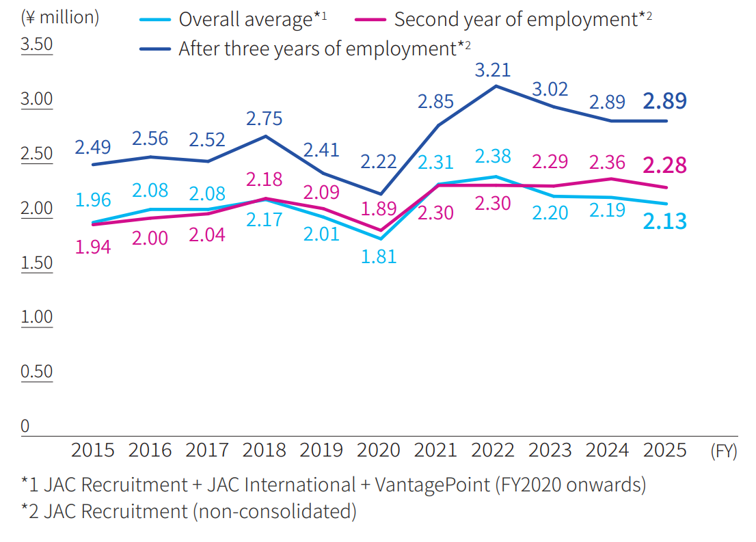
As a result of these onboarding initiatives, second-year employees have maintained a high level of productivity despite the increasing number of less experienced employees. In FY2025, productivity among second-year employees reached 2.28 million yen, exceeding the overall average.
Monthly Productivity per Consultant
The Group has adopted a career development framework that enables each employee to make the most of their abilities and contribute to the growth of the entire Company. Each employee is presented with five career paths, such as the consultant career path, upon joining the Company, and their path is reviewed periodically.
In FY2025, we launched the Career Dialogue, a series of individual career dialogues held with the HR Division, to develop careers and reduce turnover. In FY2025, the programme was conducted for about 460 new graduates and mid-career employees in their second or third year at the Company. In FY2026, we plan to expand the scope to approximately 800 individuals, including managers and other personnel in the consultant division.
To foster an organisation and corporate culture capable of sustainable growth, it is important to secure and train managers who will lead our growing number of consultants. As part of our efforts to secure managers, we hold Next Manager Training for candidates recommended by division heads and offer them the opportunity to be promoted twice each year.
To train our managers, we have established a Mission & Duty for managers and conduct training for each layer on a regular basis. We have clarified the Mission & Duty of each layer, and by putting them into practice, we are working to raise the level of management to be more sophisticated and refined. In addition, we offer online training programmes and workshops to encourage growth as managers, which involve elements such as discussions on how to incorporate the JAC Standard into the operation of one’s own division, team building, member evaluation methods, compliance, and various other topics necessary for organisational management.
|
Training content |
Initiatives |
|
Training for new managers |
Implemented a programme for new managers to acquire an understanding of their role as a manager and the basic management skills and mindsets concerning the nurturing of subordinates which goes along with it |
|
Training for management skills |
Systematic learning of practical skills such as teambuilding, goal setting, evaluation, and feedback |
|
Leadership training |
Training to strengthen decision-making skills, influence, and the ability to drive innovation in order to cultivate the ability to lead an organisation |
|
Programme for the nurturing of successors |
A selective training programme for high performers to enhance their perspectives as future executive candidates |
|
Combination of on-the-job training and group training |
Talent development plans which balance learning through practical experience and systematic knowledge acquisition |
|
Training evaluations and improvements undertaken with an awareness of ROI |
Visualise post-training behaviour changes and results to ensure that continuous improvements take place and that ROI is maximised |