
Salary transparency has become one of the most debated topics in hiring. Yet many organisations still choose not to list salary in job advertisements — often to preserve flexibility, accommodate a wide skills range, or align internally before committing to a number.
What is often overlooked is this: candidates don’t wait for answers.
Our recent survey results show that when salary is missing, candidates immediately form assumptions and those assumptions shape how they engage with the role, the interview process, and ultimately the offer.
This article explores what those assumptions reveal about candidate behaviour, and how employers can respond strategically without oversimplifying a complex issue or positioning either side as “right” or “wrong.”
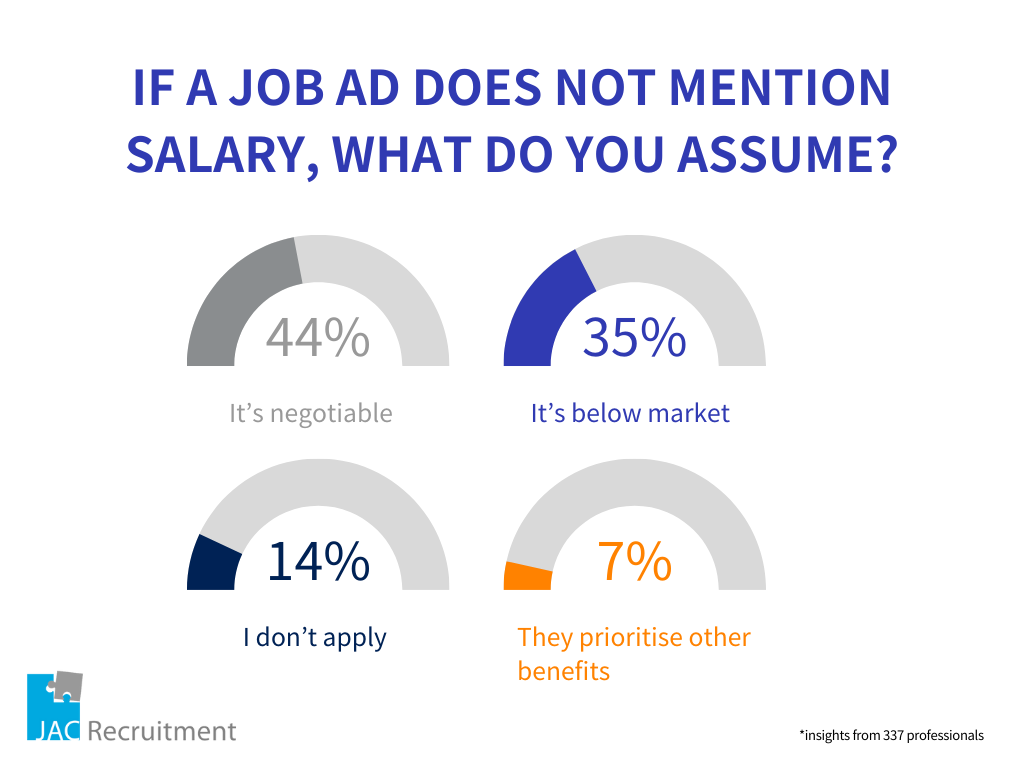
When asked “If a job ad does not mention salary, what do you assume?”, responses fell into four clear patterns:
- 44% assume the salary is negotiable
- 35% assume it is below market
- 14% choose not to apply at all
- 7% assume the company prioritises other benefits
* insights from 337 professionals
The key takeaway is not that candidates demand full transparency. It is that when salary information is missing, candidates do not stay neutral. They form their own assumptions.
Candidates do not treat missing salary as “to be discussed later.” They treat it as a signal and respond accordingly.
For employers, this means decision-making begins before the first conversation:
- Some candidates apply while mentally discounting the role
- Some apply with a salary anchor already in mind
- Some opt out altogether to avoid uncertainty
Recommendation
View salary clarity as part of expectation-setting, not disclosure. If a precise figure is not possible, consider:
- a broad salary range
- a level-based framework
- or a short explanation of how compensation is determined
Reducing uncertainty early improves alignment later.
The largest group of respondents assumes salary is negotiable.
This often attracts candidates who are more comfortable negotiating, while others may approach the process cautiously or defensively.
In both cases, the employer risks losing control of the initial anchor, which plays a significant role in shaping final outcomes.
Recommendation
Where possible, establish a visible anchor:
- even a wide range
- or a clear statement such as “market-aligned salary bands based on experience and role scope”
This approach preserves flexibility while reducing friction.
The greater cost often appears later in the process. When expectations are unclear at the outset, employers may experience:
- late-stage candidate withdrawal
- prolonged interview cycles
- misalignment that emerges only after significant time investment
The impact is not just fewer applicants, it is lower-quality conversations.
Recommendation
Treat salary clarity as a process-efficiency tool:
- align internally on acceptable ranges before going to market
- ensure recruiters and hiring managers share the same expectations
Early alignment reduces rework, delays, and frustration on both sides.
Only a small portion of respondents interpret missing salary as a signal that benefits matter more.
This suggests that generic statements such as “competitive benefits” or “great culture” rarely compensate for pay ambiguity.
Candidates do value benefits but without context, they struggle to evaluate their relevance.
Recommendation
If benefits are a genuine differentiator:
- provide tangible examples where possible
- explain how benefits complement compensation rather than substitute it
Even directional context, such as bonus structure, flexibility expectations, or development support, helps candidates assess the overall package more accurately.
For experienced candidates, a missing salary can sometimes signal:
- unapproved or fluid budgets
- internal misalignment
- unclear role scope or seniority
Even when these assumptions are incorrect, they influence confidence in the opportunity.
Recommendation
If compensation depends on experience or seniority, state this directly.
Short, honest explanations tend to build more trust than polished ambiguity.
Candidates who choose not to apply are often:
- already employed
- in-demand
- selective about where they invest time and effort
These candidates are not disengaged, instead they are efficient.
Recommendation
For senior, specialist, or hard-to-fill roles, salary clarity becomes a talent-access strategy, not a compliance exercise. Even partial transparency can improve engagement with passive talent who would otherwise self-select out.
Deciding whether, and how, to disclose salary is rarely straightforward.
Transparency does not require committing to a fixed number. It means reducing uncertainty, improving alignment, and strengthening trust throughout the hiring process. Employers who approach salary clarity strategically are not giving up leverage. They are creating better conversations, clearer expectations, and more predictable hiring outcomes, for themselves and for candidates alike.
If you are reviewing how salary clarity fits into your hiring strategy, our specialised consultants can help you benchmark roles, align internal expectations, and shape job ads that support stronger hiring outcomes.