
To build a sustainable future, it is essential to address climate change, starting with the reduction of greenhouse gases (GHG). Doing so will make it possible to protect the lobal environment, maintain a balance between ecosystems, and provide a better environment for future generations. In terms of how these issues affect JAC Group, as temperatures rise and the severity of natural disaster worsens, the potential impacts on JAC Group's operations and performance, including shifts in the corporate recruitment business and cost structures, become increasingly significant.
To address this, the Group takes climate change risk seriously and is committed to promoting sustainable business operations. Following the recommendations by the Task Force on Climate-related Financial Disclosures (TCFD), we are establishing a governance framework, identifying and evaluating risks and opportunities to enable strategic planning, managing risks, and setting metrics and targets.

We have established a governance framework that defines management’s role in assessing and managing climate change risks and opportunities, as shown in the figure below.
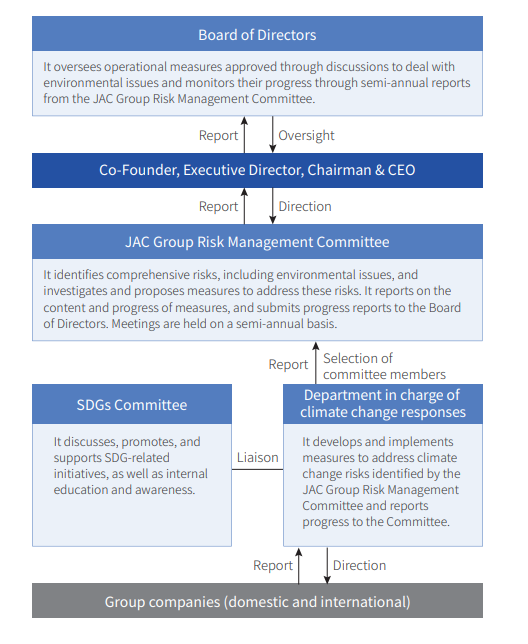
JAC Group identifies and assesses risks and opportunities in relation to our business based on the 1.5° C and 4° C scenarios published by external organisations such as the International Energy Agency (IEA) and the Intergovernmental Panel on Climate Change (IPCC).
Referenced scenarios
|
1.5℃ scenario |
|
|
4℃ scenario |
|
IEA: International Energy Agency
IPCC: Intergovernmental Panel on Climate Change
RCP: Representative Concentration Pathways
The key opportunities and risks, as well as the timescales and financial implications that we have identified and analysed based on the above scenarios, are as follows:
|
Scenarios |
Opportunities/Risks |
Event |
Timeframe |
Financial impact |
|
|
1.5°C scenario |
Transition opportunities |
Market |
Increased demand for environmental and energy-related talent on the back of decarbonisation and energy efficiency efforts across all sectors |
Short/medium term |
Increase in revenue |
|
Revitalisation of the job market as a result of policy shifts by companies towards achieving net-zero emissions in certain sectors as well as changes in the employment environment |
Short/medium term |
Increase in revenue |
|||
|
Transition risks |
Market |
Job losses in fossil fuel‒related industries |
Short/medium term |
Decrease in revenue |
|
|
Decreased number of placements due to a shortage of environmental and energy-related talent |
Short/medium term |
Decrease in revenue |
|||
|
Policy and legal |
Surge in electricity costs due to a sudden shift to energy conservation and green electricity |
Short/medium term |
Increase in costs |
||
|
4°C scenario |
Physical risks |
Acute |
Decreased job listings due to worsening corporate performance from increased natural disasters |
Long term |
Decrease in revenue |
|
Strengthened disaster preparedness due to increased natural disasters |
Long term |
Increase in costs |
|||
|
Increase in disasters and living costs due to climate change |
Long term |
Decrease in revenue |
|||
|
Chronic |
Increased electricity costs due to decreased cooling efficiency of air-conditioning systems as temperatures rise |
Long term |
Increase in costs |
||
|
Decreased productivity due to rising temperatures |
Long term |
Decrease in revenue |
|||
In an effort to reduce CO2 emissions, JAC Group has continued forestation activities in South East Asia since 2008. As a global recruitment company, we contribute to environmental protection on a global scale. This initiative is a part of our efforts to respond to the Sustainable Development Goals (SDGs), which aim to contribute to individuals, communities, and society as a whole. We will continue to restore forests through this activity as a company-wide project to contribute to the conservation and protection of precious flora and fauna and to the reduction of global CO2 emissions.
Our approach to risks and opportunities are also as follows.
Initiatives Against Risks
Diversification of customer portfolios: addressing the risk of declining sales
As the impact of climate change is expected to vary by industry, we diversify our clients across a variety of industries to minimise impacts on our business.
Promoting energy conservation activities: responding to cost increases
We will respond to the risk of electricity rate hikes occurring due to climate change by strengthening energy conservation activities.
Responding to the Increasing Frequency and Severity of Natural Disasters
Climate change may increase both the frequency and severity of natural disasters, posing risks to our business operations. To address these risks, we have established comprehensive disaster preparedness manuals covering a wide range of emergency scenarios, including climate-related natural disasters, and work to geographically diversify our business assets. In addition, we have completed and continue to maintain the information systems required to support a transition to remote working when necessary.
Initiatives for Opportunities
Strengthening of sustainability-related recruitment
There is an increasing focus on initiatives concerning responses to climate change at various companies, leading to a rise in demand for mid-career professionals skilled in environmental and SDGs-related areas. We will seize this opportunity to expand our business by finding and securing human resources with these skills, and contribute to the acceleration of decarbonisation efforts in society as a whole.
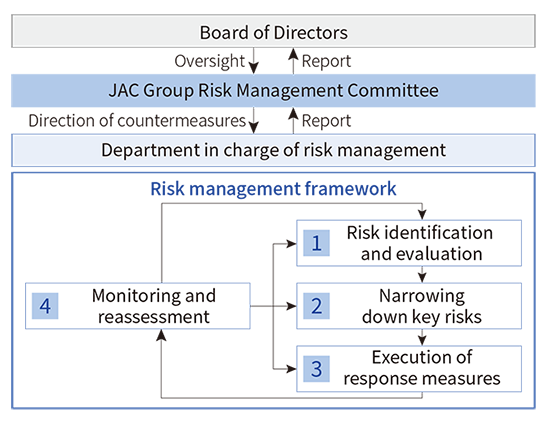
In an increasingly complex and uncertain business environment, it is essential to effectively address risks that can have a significant impact on business operations in executing management strategy and achieving business objectives. We consider risk management a vital initiative for enhancing corporate value and have established the Risk Management Committee chaired by the Co-Founder, Executive Director, Chairman & CEO. The Committee is in charge of identifying and addressing various risks we could face.
Climate change risk is also recognised as one of the risks that can have a profound impact on JAC Group’s operations. Within this framework, we narrow down and monitor key risks, continually reassessing their implications and potential consequences.
The Group has set a target to achieve carbon neutrality by FY2030 as our greenhouse gas emission reduction goal, encompassing Scope 1 to 3 emissions. We are committed to reducing GHG emissions in our business activities, procuring green electricity, and expanding GHG absorption through forestation efforts. In addition, by placing personnel who foster innovation, we aim to drive the transition to carbon neutrality across society.
In FY2026, the Group submitted a commitment letter to the Science Based Targets initiative (SBTi) as part of our efforts to obtain validation of our Science Based Targets (SBT). Going forward, we will establish science-based greenhouse gas emissions reduction targets and seek to obtain SBT validation.
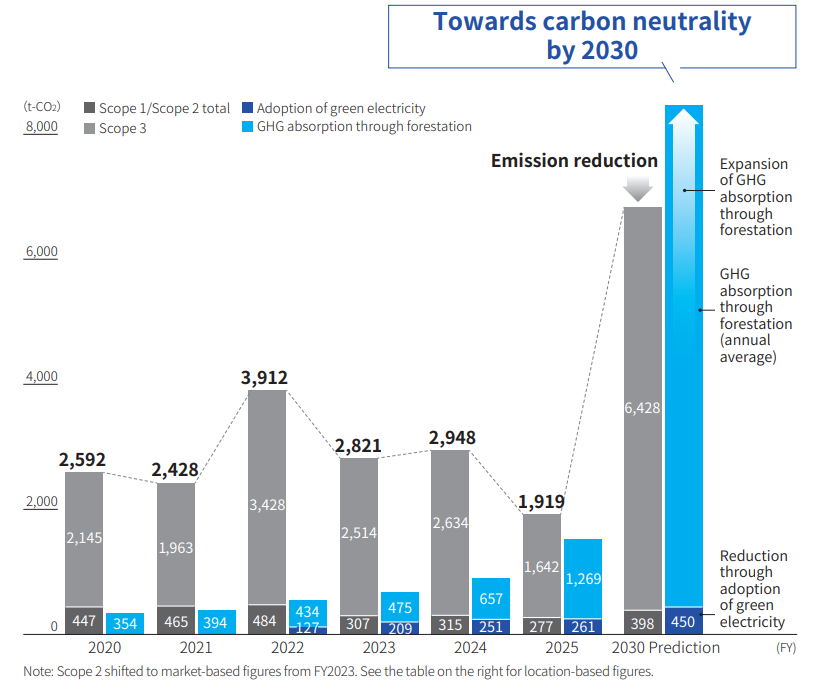
The Group has been calculating GHG emissions at all domestic and international locations, including subsidiaries, since FY2020. In addition, starting in FY2023, both location-based and market-based criteria are calculated for Scope 2.
In FY2025, GHG emissions (Scope 1 + 2 + 3; market basis) were 1,919 t-CO2e, down 35% from the previous year.
JAC Group has also obtained third-party verification from SOCOTEC Certification Japan Co., Ltd. for three consecutive years starting in FY2021.
Greenhouse Gas (GHG) Emissions Details
|
Items |
Units |
Year to 31 Dec 2023 |
Year to 31 Dec 2024 |
Year to 31 Dec 2025 |
|
|
GHG emissions |
Scope 1 |
t-CO2e |
0 |
0 |
0 |
|
Scope 2 (location-based) |
t-CO2e |
506 |
567 |
538 |
|
|
Scope 2 (location-based) |
t-CO2e |
307 |
315 |
277 |
|
|
Scope 1+2 (location-based) |
t-CO2e |
506 |
567 |
538 |
|
|
Scope 1+2 (market-based) |
t-CO2e |
307 |
315 |
277 |
|
|
Emission intensity (location-based) |
t-CO2e/billion yen in sales |
14.7 |
14.5 |
12 |
|
|
Emission intensity (location-based) |
t-CO2e/billion yen in sales |
8.9 |
8.0 |
6 |
|
|
Category2 |
t-CO2e |
1,068 |
1,071 |
553 |
|
|
Category3 |
t-CO2e |
73 |
82 |
80 |
|
|
Category5 |
t-CO2e |
667 |
687 |
86 |
|
|
Category6 |
t-CO2e |
248 |
279 |
327 |
|
|
Category7 |
t-CO2e |
459 |
514 |
595 |
|
|
Scope 3 subtotal |
t-CO2e |
2,514 |
2,634 |
1,642 |
|
|
Total (Scope 1 + 2 + 3) |
t-CO2e |
2,821 |
2,948 |
1,919 |
|
|
Energy consumption |
Petrol, etc. |
kWh |
0 |
0 |
0 |
|
Electricity consumption |
kWh |
1,064,244 |
1,201,488 |
1,178,260 |
|
|
Energy Consumption Intensity |
kwh/billion yen in sales |
30,870 |
30,685 |
25,565 |
|
|
Of which, green electricity |
kWh |
490,304 |
567,600 |
602,141 |
|